


The History of NLP in 3 Minutes: How We Got to LLMs
For years we’ve been talking about models, architectures, embeddings, Transformers, LLMs…
But we rarely stop to look at the full journey.
That’s why today I want to pause the series and tell a story. A story that starts long before ChatGPT, long before Transformers, even long before neural networks.
The story of how AI learned to understand and generate language.
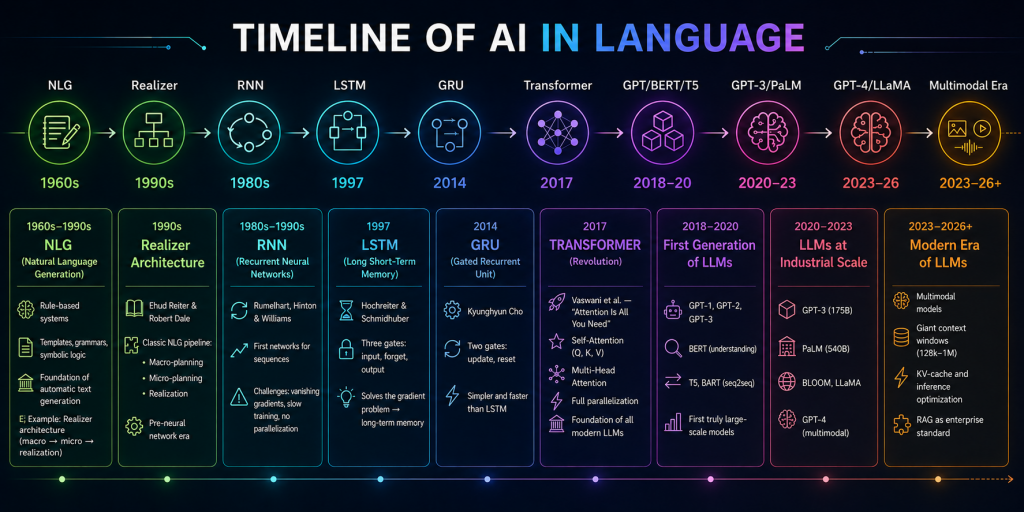
The 60s-90s: The symbolic world
It all started when there were no GPUs, no deep learning, no massive datasets.
Just hand-written rules, templates, and grammars.
NLG (Natural Language Generation) systems ran on pure logic:
- If you wanted to generate «The user bought a book», you had to program that exact structure
- Macro-planning → Micro-planning → Realization
- Architectures like Realizer (Ehud Reiter & Robert Dale) defined the classic pipeline
It was a deterministic world. Predictable. Limited.
But the idea was already there: teaching a machine to speak.
The problem? It didn’t scale. Every new domain required rewriting the rules from scratch.
The 80s-90s: Recurrent neural networks arrive
Decades later, RNNs emerged (Rumelhart, Hinton & Williams).
Finally, a model could «remember» what came before in a sequence.
But they had a critical flaw: vanishing gradients.
After 10-15 steps, the network forgot everything. It couldn’t learn long-range dependencies.
It was like trying to remember the beginning of a sentence while reading the end… and failing systematically.
1997: The first major leap — LSTM
Hochreiter and Schmidhuber introduced LSTM (Long Short-Term Memory).
Three magic gates: input, forget, output.
Long-term memory. Gradient stability.
For the first time, a network could retain information for hundreds of steps.
It could learn that «the cat that was on the roof» relates to «meowed» 20 words later.
It was a watershed moment.
LSTMs dominated NLP for nearly 20 years.
But they were still sequential. You couldn’t parallelize training. And that limited their scale.
2014: GRU — The simplified version
Kyunghyun Cho proposed GRU (Gated Recurrent Units).
Two gates instead of three. Faster. Simpler.
They weren’t revolutionary, but they proved something important:
Sometimes, less complexity is better.
2017: The moment that changed everything
Google published «Attention Is All You Need».
And they were right.
Transformers eliminated sequential dependency.
Attention enabled:
- Parallelizing training (processing the entire sequence at once)
- Scaling to millions of parameters
- Capturing long-range relationships without degradation
- Training massive models in weeks, not years
The architecture was elegant:
- Self-Attention (Q, K, V)
- Multi-Head Attention (multiple simultaneous perspectives)
- Full parallelization (goodbye to sequential bottlenecks)
Transformers weren’t an improvement.
They were a paradigm shift.
Everything we call LLM today was born here.
2018-2020: The first generation of LLMs
GPT-1, GPT-2, GPT-3.
BERT (understanding), T5 (text-to-text), BART (seq2seq).
Models that didn’t just process language: they understood it, generated it, transformed it.
GPT-3 (175B parameters) was the inflection point:
- Few-shot learning without fine-tuning
- Coherent long-form generation
- Emergent reasoning capabilities
Industry started paying attention.
2020-2023: The industrialization of language
GPT-3, PaLM (540B), BLOOM, LLaMA.
Models became larger, more capable, more accessible.
But also more expensive to train.
And that’s when the race for efficiency began:
- Smaller models, better trained
- Specialized fine-tuning
- Democratization (LLaMA, Falcon, Mistral)
GPT-4 arrived with multimodality (text + image).
The line between «language model» and «general understanding model» started to blur.
2023-2026+: The modern era
We’re here. And this is what defines this stage:
1. Multimodality
Models no longer just read text. They process images, audio, video, code.
GPT-4, Gemini, Claude 3 are general understanding models.
2. Massive context windows
From 4k tokens (GPT-3) to 128k, 200k, even 1M tokens (Gemini 1.5).
You can fit entire books, complete codebases, days-long conversations.
3. Inference optimization
KV-cache, sparsity, Mixture of Experts (MoE).
Models that reason faster, consume less memory, scale better.
4. RAG as enterprise standard
Retrieval-Augmented Generation: combining LLMs with external knowledge bases.
The most practical way to bring AI to production without retraining massive models.
5. Models that reason
They don’t just respond anymore. They plan, decompose problems, verify their own answers.
Chain-of-Thought, ReAct, Tree of Thoughts.
We’re living through the revolution in real time.
Why tell this story now?
Because before diving into the Scikit-Learn block —estimators, transformers, pipelines— it’s worth remembering something:
Nothing we use today appeared out of nowhere.
Every concept, every architecture, every technique…
is the result of 60 years of iteration, research, and learning.
When you use aPipelinein Scikit-Learn, you’re applying ideas that trace back to the symbolic systems of the 60s.
When you train a model withfit(), you’re using concepts that evolved from RNNs.
When you implement RAG, you’re combining Transformers (2017) with classic retrieval (decades earlier).
Understanding the past prepares you to understand what’s coming.
And what’s coming is big:
- Adaptive models that learn in real time
- Continual learning without forgetting
- Nested Learning (models that train models)
- AI that doesn’t just respond, but investigates, verifies, and improves
Final thought
AI didn’t appear overnight.
It’s the result of decades of people who:
- Tried ideas that didn’t work
- Iterated on architectures that failed
- Published papers nobody read at the time
- Stood on the shoulders of giants
And now, you’re here.
Learning the tools that will let you build what comes next.
Before continuing the series, look back.
Because understanding where we came from is the best way to understand where we’re going.
TL;DR
- NLP has a 60‑year history.
- We moved from rules → RNN → LSTM → Transformers → multimodal LLMs.
- Each breakthrough solved a limitation of the previous era.
- Modern AI (pipelines, estimators, RAG) is built on decades of evolution.
- Understanding the past prepares you for the future.
AI is not something that “started in 2020.” It’s the product of six decades of continuous evolution.