



Autoencoders
The neural network that learns to look at itself in the mirror
How a machine learns to compress, reconstruct, and understand the essence of data.
In Deep Learning there are models that classify, others that predict, others that generate…
And then there are Autoencoders, which do something far more curious:
They learn to copy.
But by copying… they learn to understand.
It might sound strange. What’s the point of training a network to reproduce the exact same input you give it? The key isn’t what it does, but how it does it.
The core idea: compress to understand
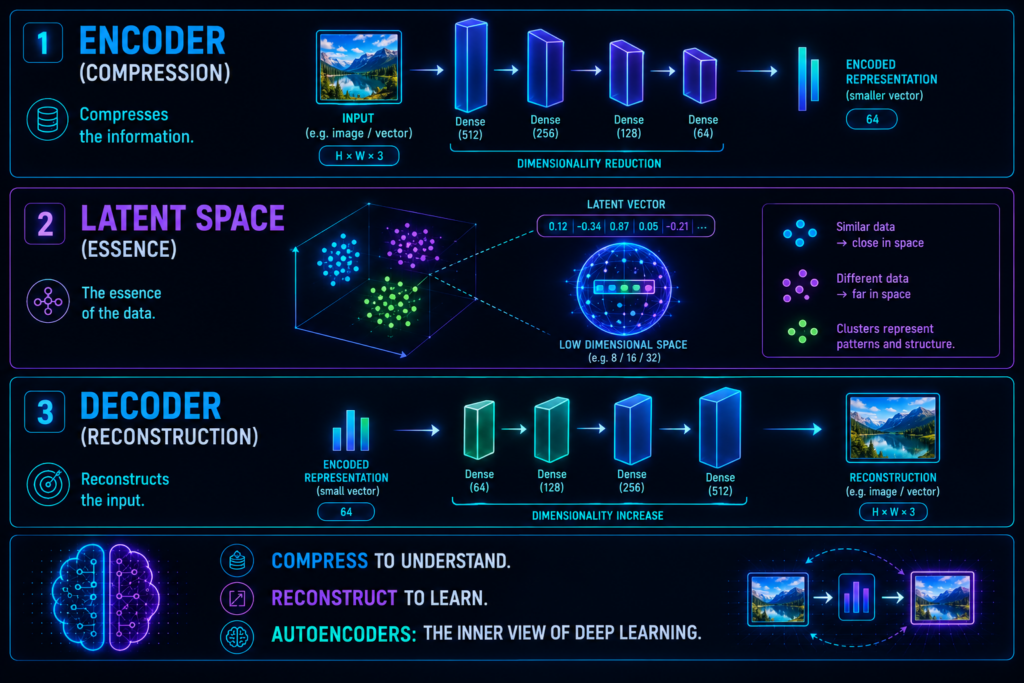
An Autoencoder has two parts:
- Encoder → compresses the data.
- Decoder → reconstructs it.
Between the two there’s a critical point: a small, narrow, compressed space called the latent space. That’s where the magic happens.
The network takes a piece of data (an image, a vector, a sound), flattens it, shrinks it, squeezes it down to just a few numbers… and then tries to reconstruct it from that compressed version.
If it succeeds, it means it has learned the essence of the data.
An example to picture it. It’s like asking someone to summarize an entire book in a single sentence, and then reconstruct the whole book from that sentence. If they can do it, it’s not because they memorized the pages: it’s because they truly understood what the book was about. An Autoencoder does exactly that, but with images, sounds, or vectors.
How does an Autoencoder work?
The process is simple but deep:
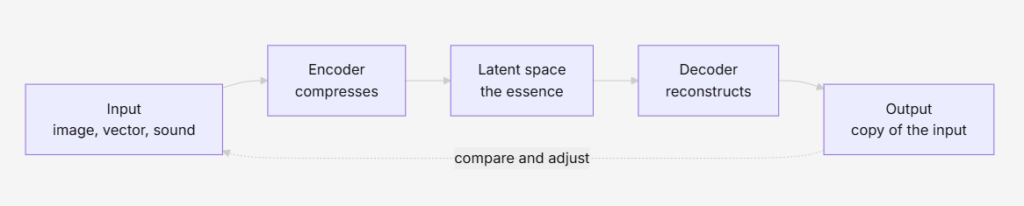
- Input. You give it an image, a vector, an encoded piece of text…
- Encoder. The network reduces the information to a small vector: the latent space, the compressed essence.
- Decoder. From that vector, it tries to reconstruct the original input.
- Loss. It compares the reconstruction with the real input and adjusts weights to improve the copy.
And it repeats. Thousands of times. Until it learns to compress without losing what matters.
Why is this mechanism so powerful?
Because by forcing the network to compress, you force it to understand.
An Autoencoder doesn’t memorize, doesn’t copy pixel by pixel, doesn’t store the image in its memory. It has to discover which parts are essential, which patterns repeat, what internal structure the data has, and what can be discarded without losing meaning.
It’s like learning to draw a face: you don’t memorize every pore, you memorize the shape, the proportion, the essence.
The intuition: learning to see
An Autoencoder is a network that learns to look at itself in the mirror. It observes itself and asks:
«Which part of this image is really important?»
«What can I compress without losing identity?»
«What defines this piece of data?»
And in doing so, it learns deep representations. Representations that later serve to detect anomalies, reduce dimensionality, generate new data, clean up noise, create embeddings, or pretrain larger models.
It’s a tool for understanding, not for classifying.
The latent space: the heart of the Autoencoder
That compressed vector -sometimes with 2, 10, or 128 dimensions- is a map. A map where similar images end up close together, different ones end up far apart, concepts organize themselves, and unexpected relationships emerge.
It’s like watching how the network organizes the world in its head.
If you train an Autoencoder on faces, the latent space learns on its own to distinguish smile from seriousness, light from shadow, the shape of the face, the orientation, the style… without anyone telling it to.
Important variants
Although the classic Autoencoder is simple, there are more powerful versions:
| Variant | What makes it special | What it’s used for |
|---|---|---|
| Denoising Autoencoder | Takes noisy data and learns to reconstruct the clean version | Removing noise, restoring damaged data |
| Sparse Autoencoder | Forces the latent space to be very small or very sparse | Extracting the most essential features |
| Variational Autoencoder (VAE) | Doesn’t just compress: it generates new data | Image generation, one of its pillars |
Why is it relevant for embeddings?
Because an Autoencoder is, in essence, a representation machine. And an embedding is exactly that: a compressed representation that captures meaning.
Autoencoders were one of the first methods capable of learning deep representations without supervision. They’re the natural bridge toward Word2Vec, GloVe, modern embeddings, Transformers, and generative models.
In summary
An Autoencoder is a network that learns to compress and reconstruct data. But in that process it learns something far more valuable: the internal structure of the world it observes.
It’s a tool for understanding, not for classifying. For discovering patterns, not for labeling. For learning meaning, not for memorizing.
And it’s the first step toward embeddings, the vector language used by every modern network.