





Regularization + Transfer Learning
How to stop networks from forgetting, saturating, or overfitting
The art of taming deep networks and teaching them to learn without losing their way.
In the previous chapter we saw how Backpropagation lets a network learn: it propagates the error backwards, computes gradients, and adjusts millions of weights until it masters a pattern.
But learning isn’t enough.
Learning well is what really matters.
A deep network can memorize the dataset, saturate, forget what it learned, become unstable, or overfit until it’s useless on new data. It’s like a student who knows the textbook by heart, word for word… but understands nothing and freezes the moment you rephrase the question.
To avoid this, Deep Learning developed two big tools:
- Regularization → prevent overfitting.
- Transfer Learning → learn faster by reusing prior knowledge.
Let’s take them one at a time.
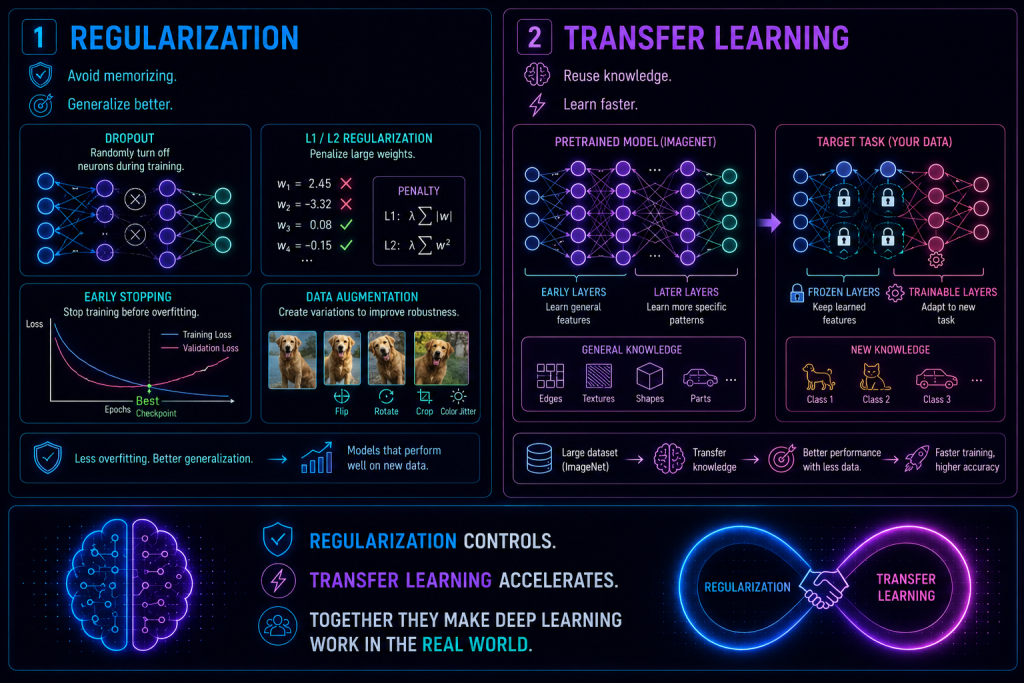
Regularization
Stopping the network from memorizing and losing its ability to generalize
A deep network has millions of parameters. That means that, left unchecked, it can learn too much: memorizing every example, every bit of noise, every irrelevant detail in the dataset.
Regularization is the art of telling it:
«Learn, but don’t obsess.»
An example to picture it. Imagine a student who memorizes the last 100 exams letter by letter. On the practice test they ace it. But on the real exam, with new questions, they collapse: they never learned the concept, they just copied answers. That’s exactly overfitting. Regularization forces the network to understand the pattern instead of memorizing the exam.
There are several ways to achieve it.
1. L1 and L2: penalizing large weights
These are the classic regularizers:
- L1 pushes weights toward zero (creating sparse networks, with many weights set to zero).
- L2 pushes weights toward small values (smoothing them without zeroing them out).
The idea is simple: if a weight is huge, it’s probably memorizing noise. Penalize it. It’s like telling the network: «trust extreme details less.»
2. Dropout: switching off neurons at random
Dropout is one of the most brilliant ideas in Deep Learning. During training you switch off neurons at random, forcing the network to not depend on any single one. In practice, you’re training many different sub-networks inside the same network.
It’s like a football team where a different player is missing each day: everyone learns to play well without relying on a single star. The result is a far more robust team, and a network that overfits far less.
3. Early Stopping: stopping before things get worse
Sometimes the network starts learning well… and then, if you keep training, it starts memorizing. Early Stopping watches the loss on the validation set and says:
«That’s enough. If I keep going, I’ll only get worse.»
Simple, elegant, and very effective.
4. Batch Normalization: stabilizing the learning
Activations can saturate, explode, or become unstable as they pass through the layers. BatchNorm normalizes each layer during training, and with that it stabilizes gradients, speeds up learning, reduces sensitivity to how you initialize the weights, and, as a bonus, acts as a regularizer.
It’s like installing air conditioning in a factory: everything works better when the temperature stays steady.
5. Data Augmentation: creating new data
In vision, audio, and text you can generate variations of the dataset: rotations, crops, noise, brightness changes, synonyms, reordered words. The network sees more examples and generalizes better.
It’s like training a pilot in different weather: if they only ever practice in sunshine, they’ll fail the day it rains.
Transfer Learning
Learning faster by reusing prior knowledge
Training a network from scratch is expensive, slow, and needs enormous amounts of data. But… what if we start from a network that already knows things?
That’s Transfer Learning: a network learns a big problem, and then we reuse that knowledge for a smaller one.
It’s like learning to play the piano and then using that ear and technique to pick up the guitar: you don’t start from zero, you begin with half the journey already done.
The core idea
A network trained on a huge dataset (ImageNet, COCO, LibriSpeech…) learns very general things: edges, shapes, textures, sound patterns, linguistic structures.
That knowledge is general. It’s useful for many different problems. Transfer Learning is about taking advantage of it:

You take a pretrained network, freeze its early layers (the ones that capture general patterns), and train only the final layers for your specific task. It’s fast, cheap, and extremely effective.
Two ways to use it
| Feature Extraction | Fine-Tuning | |
|---|---|---|
| What you do | Use the network as a feature extractor and train only a classifier on top | Unfreeze some layers and readjust them with your dataset |
| How much you train | Only the final layer | Several layers |
| Ideal when | You have little data | You have more data or your task is very different from the pretraining |
| Cost | Very low | Medium |
Why does it work so well?
Because the early layers of a deep network learn universal patterns: edges, curves, textures, frequencies, syntactic structures. And those patterns are useful for almost any task.
Transfer Learning is the superpower of modern Deep Learning: it lets you train world-class models with small datasets.
In summary
Regularization stops the network from memorizing. Transfer Learning saves you from having to train it from scratch.
Together they form the duo that makes Deep Learning stable, generalizable, efficient, accessible, and practical in the real world.
- Without regularization, networks saturate and memorize.
- Without Transfer Learning, they’d be too slow and costly for most uses.
And now that we know how to control and reuse networks…
In the next series we dive into modern architectures: CNNs, RNNs, Attention, and Transformers.