


Transformers
The architecture that redefined modern NLP
Today on the blog, we’ll be talking about the Transformers—and not exactly these Transformers…
How Transformers eliminated recurrence, embraced parallelization, and gave rise to today’s language models.
So far we’ve traced the whole evolution: we saw how RNNs tried to remember step by step, how LSTMs and GRUs learned to control memory with gates, how the vanishing/exploding gradient sabotaged deep training, how Beam Search helped generate text sensibly, and, in the previous chapter, how attention made it possible to look directly at what’s relevant.
Each piece was a brilliant patch on the same underlying idea: recurrence.
But the daring question was still missing, the one that would change everything:
What if we throw recurrence in the trash and build an entire architecture based solely on attention?
In 2017, Google’s paper Attention Is All You Need answered without hesitation:
Yes. And it doesn’t just work: it crushes everything that came before.
That’s how the Transformers were born.
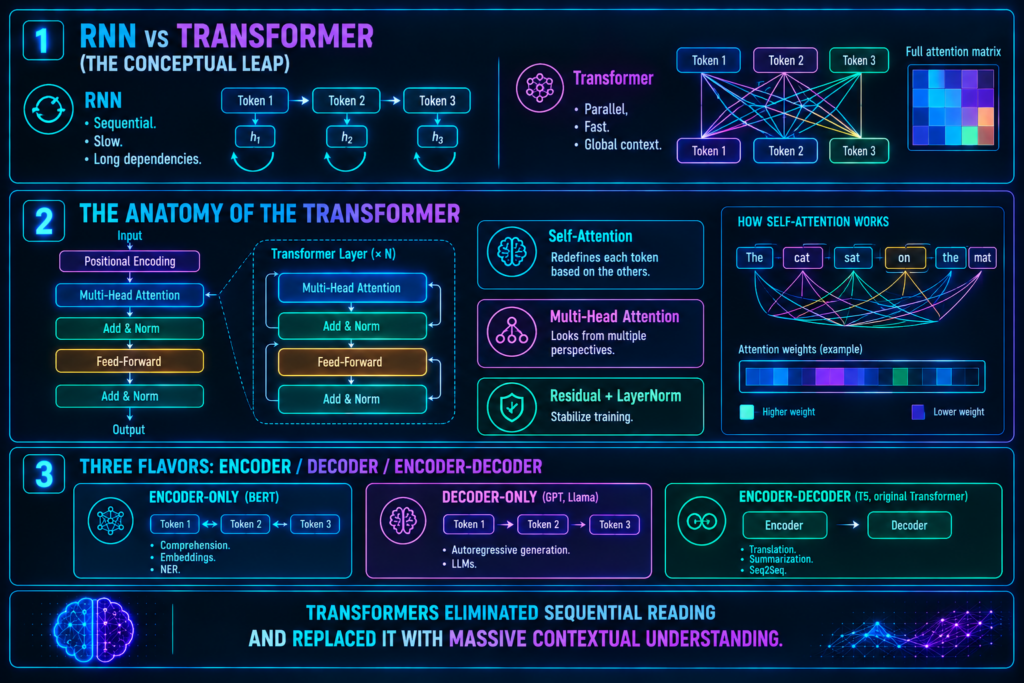
What is a Transformer?
A Transformer is a neural network that processes sequences without recurrent loops and without convolutions. Its entire engine rests on five pieces:
- Self-attention
- Multi-head attention
- Feed-Forward layers (FFN)
- Normalization (LayerNorm)
- Residual connections
The reading analogy. An RNN reads like an exhausted student at 3 a.m.: word by word, trying to hold in mind what it read three pages ago. A Transformer, in contrast, takes an aerial photograph of the entire page and observes all the words at once, instantly deciding which ones relate to each other.
By looking at everything simultaneously, it eliminates the sequential bottleneck and squeezes the parallel computing power of modern GPUs to the maximum.

Why was it a revolution compared to RNNs?
Transformers knocked down, in a single blow, the two walls that were holding back recurrent networks:
| Challenge | RNN approach | Transformer approach |
|---|---|---|
| Training speed | Token by token (impossible to parallelize over time) | All tokens at once (massive parallelization) |
| Long-distance dependencies | The signal crosses dozens of steps and degrades (vanishing gradient) | The distance between any pair of words is exactly 1 |
That detail of logical distance 1 is key: a word located at the end of a 4,000-token document can directly consult the beginning of the text, with no intermediaries and no memory loss along the way. This is exactly what opened the door to training on enormous corpora from the internet.
The Transformer’s anatomy, piece by piece
Although variants exist, all Transformers share the same fundamental blocks stacked in layers.
1. Embeddings + Positional Encoding
Pure attention is blind to order: it sees the sentence as a bag of words floating with no rows or turns. On its own, it wouldn’t distinguish «the dog bit the man» from «the man bit the dog.»
The Positional Encoding injects a mathematical signal (a pattern of waves and positions) that tells each token exactly what place it occupies in the line. It’s like giving each word a seat number.
2. Self-Attention
Each token asks itself: «Which other words in this sentence do I need to look at to understand my own meaning?»
In the sentence «The animal didn’t cross the street because it was tired,» the word «it» directs its attention strongly toward «animal» and practically ignores «street.» The context emerges on its own, with no hand-programmed rules.
3. Multi-Head Attention
Instead of a single global attention, the Transformer launches several «heads» in parallel, each specialized in a type of relationship:
- One tracks syntax (subject–verb).
- Another resolves pronouns and coreferences (it, that).
- Another detects entities and proper nouns.
- Another captures the temporal context.
Then all those perspectives are concatenated into a single enriched representation. It’s like having several expert readers analyzing the same sentence at once.
4. Feed-Forward Networks (FFN)
After attention, each token passes through a small dense network that processes, refines, and projects the information just captured. It’s the step where the model «digests» what attention just pointed out to it.
5. Residual Connections + LayerNorm
Residual connections create highways through which gradients travel without degrading (goodbye again to the vanishing gradient), and LayerNorm keeps the numerical values stable from layer to layer so nothing blows up.
The three flavors: Encoder, Decoder, or both
Depending on how these blocks are arranged, we get three major families of architectures:
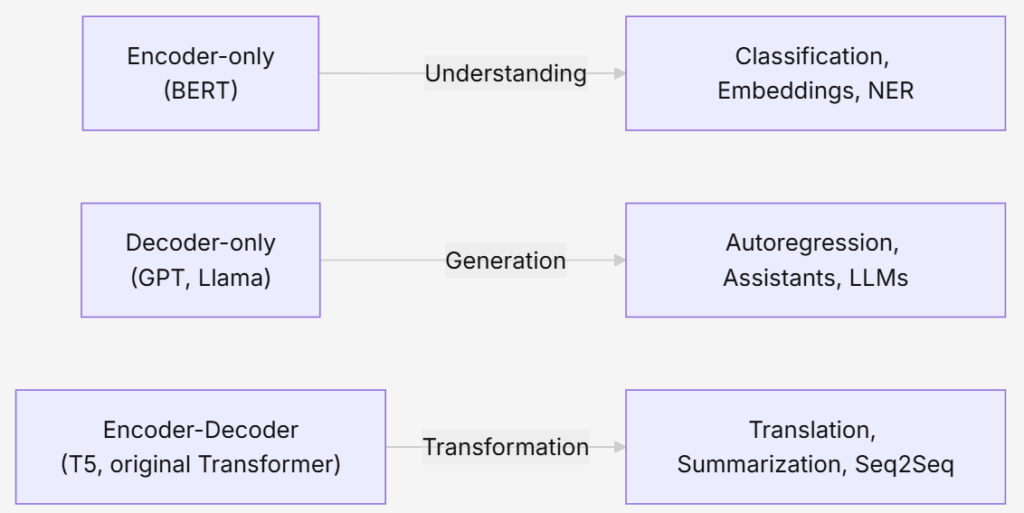
| Architecture | Flagship model | Specialty | How it processes context |
|---|---|---|---|
| Encoder-only | BERT | Understanding and analysis | Fully bidirectional (looks at past and future) |
| Decoder-only | GPT, Llama | Autoregressive generation | Causal (only looks at previous words) |
| Encoder-Decoder | T5, BART | Sequence transformation | The encoder reads the input, the decoder generates the output |
Why do they scale so well?
The overwhelming success of Transformers didn’t come only from their mathematical elegance, but from their love affair with hardware:
- Massive matrix operations: multiplying gigantic matrices is exactly what GPUs and TPUs were born for.
- Distributed training: thousands of cards can process entire batches at once, without waiting for step-by-step temporal dependencies.
- Scaling laws: with more parameters and more data, performance improves predictably, without stalling.
Recent optimizations like FlashAttention (a much smarter management of GPU memory) and encodings like RoPE have stretched context windows from the 512 tokens of the original paper to hundreds of thousands or even millions.
The global impact: far beyond text
Today, practically any cutting-edge model —GPT-4o, Claude, Gemini, Llama— is a Transformer under the hood. And the architecture broke the boundaries of language:
- Vision Transformers (ViT): handle images by splitting them into small patches, as if each piece were a «word.»
- Audio and speech: models like Whisper transcribe by processing spectrograms.
- Multimodality: text, image, video, and code coexisting in a single latent space.
- Mixture of Experts (MoE): they boost the number of parameters by activating only specialized subnetworks for each token, gaining size without exploding the cost.
Transformers didn’t just change NLP: they redrew all of artificial intelligence.
In summary
Transformers completed the turn NLP had been chasing for years:
- They eliminated recurrence, wiping out sequential slowness in one stroke.
- They enabled total parallelization, making it possible to train on practically the entire web.
- They solved long dependencies, connecting any pair of concepts in a single step.
- They scaled to unthinkable sizes, up to billions of parameters.
- They became the engine of modern AI, proving that attention wasn’t an accessory, but the foundation of everything.
They are the definitive bridge between attention and today’s generative AI. The exact moment when language processing stopped being a slow, blind read… and became contextual, massive, and scalable understanding.