





Iterative training: why the first model is almost never the one that reaches production
How data scientists improve models through continuous experimentation
The art of trying, measuring, learning, and starting over.
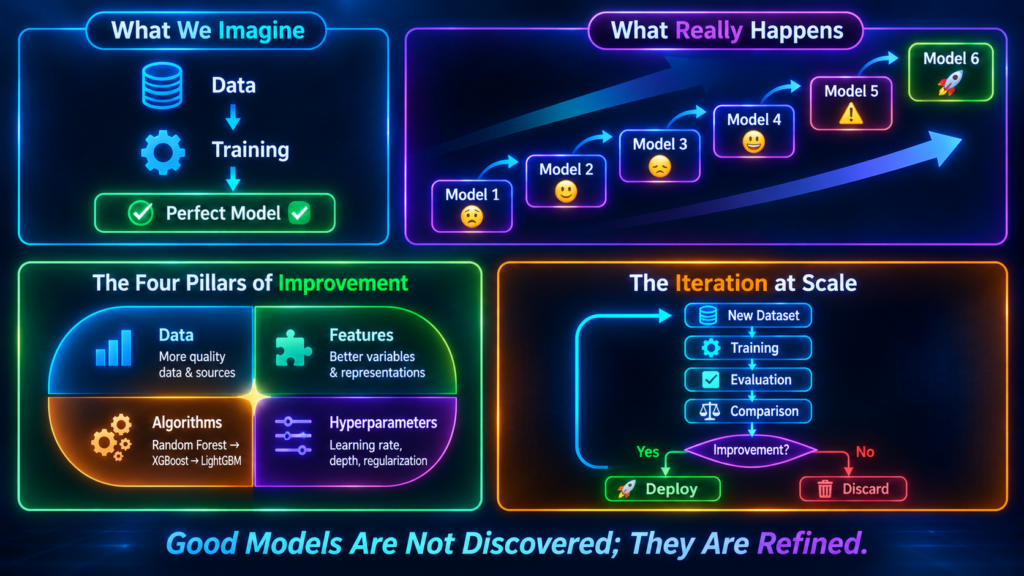
When we imagine Machine Learning, almost all of us picture something like this:

It’s a clean, orderly image, and completely wrong.
The day-to-day reality is far less elegant. A Machine Learning project rarely produces a good model on the first try. In fact, there’s an unwritten rule that every professional eventually internalizes:
If your first model is the one that ends up in production, you probably haven’t experimented enough.
The vast majority of successful models aren’t born from a brilliant idea arriving in a flash of inspiration. They’re born from dozens, hundreds, or even thousands of consecutive experiments.
Because Machine Learning looks far less like building a bridge (where you follow a fixed blueprint and the result is guaranteed) and far more like scientific research:

And start over, again and again.
1. The myth of the perfect model on the first try
There’s a widespread fantasy among beginners: the idea that progress is a straight, upward line.
Reality looks more like a roller coaster, where the model sometimes improves, sometimes gets worse, and only after many stumbles reaches a good destination:

Progress is rarely linear. It’s a process of trial and error, with steps forward and steps back. And that, far from being a failure, is exactly how it’s supposed to work.
2. Data scientists don’t train models: they design experiments
This is the key mindset shift. An experienced professional doesn’t think «I’m going to train a model.» They think «I’m going to test a hypothesis.»
Each run seeks to answer a specific question:
- What if I add new variables to the model?
- What if I remove the noise from the data?
- What if I change the algorithm entirely?
- What if I tune the hyperparameters?
- What if I bring in more data from another source?
Each training run is, in essence, a hypothesis put to the test.
The pharmaceutical lab analogy. Think of a researcher developing a new drug. They don’t synthesize the perfect formula on their first day of work. They follow a cycle: they have an idea, test it in the lab, observe the result, adjust the composition, and test again. They repeat that loop dozens or hundreds of times, discarding compounds that don’t work, until they find the one that does. Machine Learning works exactly the same way.
3. The first model is usually bad… on purpose
Something that throws off many beginners: good teams deliberately start with simple, «bad» models.
Before diving into training a Transformer with millions of parameters, they first build something humble: a linear regression, a simple decision tree, or even a basic rule. This is called a baseline.
Why «waste time» on something we know will be weak? Because without a reference, you have no way of knowing whether your sophisticated models are actually improving anything or just adding useless complexity.
The baseline answers the most honest question of the project:
| Model | Accuracy | Cost / Complexity |
|---|---|---|
| Baseline (simple regression) | 82% | Minutes, runs on a laptop |
| Complex model (deep learning) | 84% | Days of GPU, expensive infrastructure |
Faced with that table, the uncomfortable question is inevitable: is it worth multiplying the cost by 50 to gain just 2 points? Sometimes the answer is a resounding no, and the baseline is the only thing that lets you see it clearly.
4. What changes from one iteration to the next
Improvement almost never comes from a single place. The usual approach is to experiment on four different fronts, often in parallel:
| Dimension | What you touch | Concrete examples |
|---|---|---|
| Data | The raw material | More examples, better quality, class balancing, new sources |
| Features (variables) | How you describe the problem | Creating new variables, removing noise, trying different encodings |
| Algorithms | The learning engine | Going from Random Forest → XGBoost → LightGBM |
| Hyperparameters | The «fine-tuning knobs» | Depth, learning rate, regularization, batch size |
Each adjustment, however small, generates a new experiment with its own result to measure and compare.
And here’s a golden tip that experience confirms over and over: improving the data usually pays off more than changing the algorithm. A simple model with excellent data almost always beats a sophisticated model fed mediocre data.
5. The chaos of human memory (and why MLflow and friends exist)
After twenty experiments, the disorder begins. The scenario is sadly universal:
model_1.pkl
model_2.pkl
model_8_final.pkl
model_12_final_final.pkl
model_12_final_FINAL_GOOD.pkl
And with it come the uncomfortable questions nobody can answer:
- Which of them all had the best F1?
- Which dataset did I use to train model 8?
- Which combination of hyperparameters worked best that time?
- Which exact version is deployed right now?
The human brain simply isn’t designed to remember hundreds of configurations. From this critical need, an entire discipline was born: the systematic logging of experiments.
Tools like MLflow, Weights & Biases, Neptune, or Comet exist precisely for this: automatically saving every metric, every parameter, and every version, so you can compare 50 experiments at a glance instead of trusting your memory. (They’ll be, in fact, the natural next step of this series.)
6. Improvement isn’t infinite (and failing isn’t wasting time)
Another beginner’s mistake is believing that every experiment has to improve on the previous one. That’s not the case. Plenty of iterations make the model worse.
And that’s perfectly fine.
Because in scientific research, a negative result isn’t a failure: it’s valuable information.
A failed experiment ≠ wasted time.
When an experiment goes wrong, it means you’ve just ruled out a wrong path. Now you know something you didn’t know before: that this variable doesn’t help, that this algorithm doesn’t fit, that this adjustment doesn’t work. You’ve narrowed the search space. That’s progress disguised as failure.
7. When should you stop iterating?
This is one of the hardest decisions in the whole process, because there’s always the temptation to keep optimizing just a little bit more.
But there comes a point where the improvements become insignificant:

Gaining three hundredths of a percentage point stops justifying the time invested, the computational cost, and the added complexity. This is known as diminishing returns: you invest more and more effort to obtain increasingly ridiculous improvements.
And here perhaps the most important lesson of the professional world appears:
A perfect model that is never deployed is worth less than a «good enough» model that is already generating value.
The goal isn’t academic perfection; it’s solving a real problem. Perfect is the enemy of good, and above all, the enemy of delivered.
8. When iteration becomes automated: MLOps
In mature organizations, this whole dance of experiments stops being done by hand and becomes an automated industrial process:
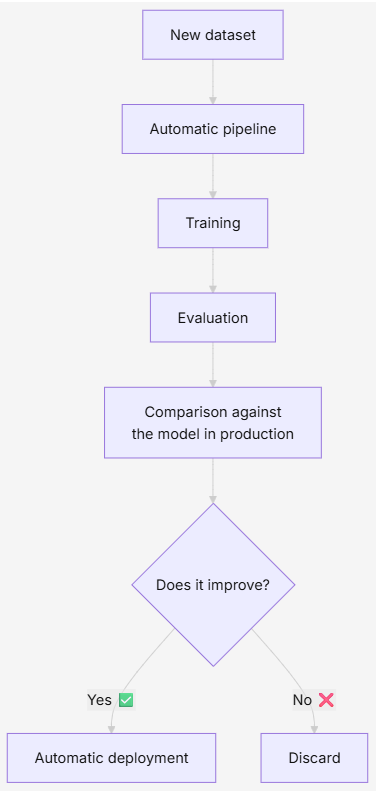
The system retrains, evaluates, and compares on its own. If the new candidate beats the one in production, it gets deployed; if not, it’s discarded with no human intervention. Experimentation, which started as a manual art, ends up turned into a reliable assembly line.
9. Great models are the sum of hundreds of small decisions
There’s a romantic temptation to look for the magic ingredient: the definitive algorithm, the secret hyperparameter, the miracle architecture that changes everything.
Reality is far humbler (and far more encouraging). Models that succeed rarely emerge from a single genius decision. They emerge from the patient accumulation of:
- better data,
- better variables,
- better ways of evaluating,
- and hundreds of small optimizations, each contributing its grain of sand.
It’s not a stroke of genius. It’s compound discipline.
In summary
Iterative training is the process by which a model evolves from a clumsy first experiment into a production-ready solution. It involves:
- building honest baselines as a starting point,
- launching experiments like someone testing hypotheses,
- measuring and comparing each result rigorously,
- learning from mistakes (which are never wasted time),
- knowing when to stop before falling into diminishing returns,
- and repeating the cycle continuously.
The most important lesson fits in a single sentence:
Good models aren’t discovered; they’re refined.
And most of the time, the difference between a mediocre model and an excellent one isn’t a revolutionary idea… but the discipline to iterate one more time.