

AutoML and PyCaret: when machines start building models for you
How to automate much of the repetitive work in Machine Learning
From manually tuning models to automatically searching for the best solution.
In the previous chapters we saw an uncomfortable truth: a good model isn’t discovered all at once, it’s refined through dozens or hundreds of experiments. But that reality hides an exhausting trap.
For years, building a Machine Learning model meant an endless manual ritual: you picked an algorithm, trained it, evaluated the results, tried another, tuned the hyperparameters, retrained… and repeated the loop over and over.
Sooner or later, data scientists discovered something that stings to admit:
Much of their valuable time went not into having new ideas, but into repeating nearly identical tasks again and again.
And from that fatigue, an inevitable question was born:
What if a machine could automate the most mechanical part of building models?
That’s how the concept of AutoML was born.
1. What is AutoML? (And what it is NOT)
AutoML stands for Automated Machine Learning. In plain terms:
Using software to automate the repetitive tasks of the Machine Learning process.
It’s worth clearing up the misunderstandings right away, because that’s where almost all the confusion lives:
- It does not mean AI will replace the data scientist.
- It does not mean pressing a magic button and solving any problem.
- It does mean reducing the mechanical work so human energy can focus on what truly matters.
The GPS analogy. Before navigation apps, driving somewhere new required unfolding a paper map, planning the route by hand, and making every decision on the fly. Today, you enter the destination and the GPS calculates the optimal route in seconds.
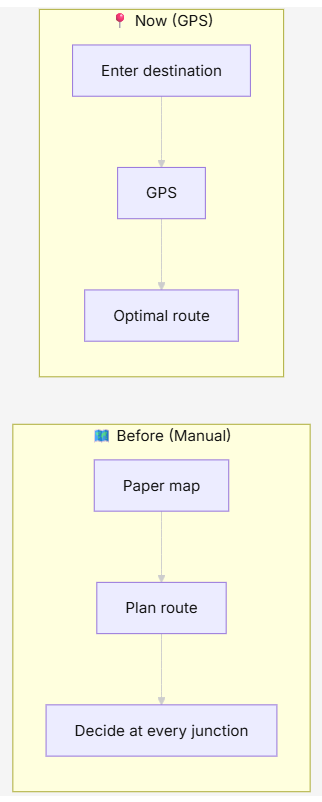
The key detail: the driver is still essential. The GPS doesn’t decide where you want to go or why. It only eliminates the repetitive work of calculating the path. AutoML does exactly that with Machine Learning.
2. The classic process vs. the process with AutoML
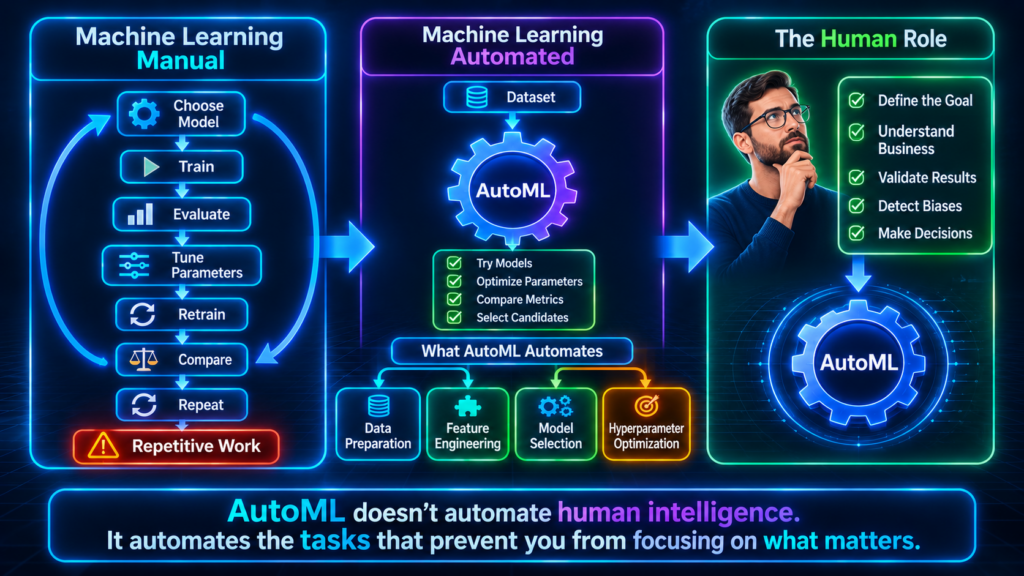
Imagine you want to solve a classification problem. The traditional flow forces you to run this circuit dozens of times by hand:

AutoML compresses that entire manual loop into a single automatic process. You hand it the data, and it takes care of the heavy lifting:
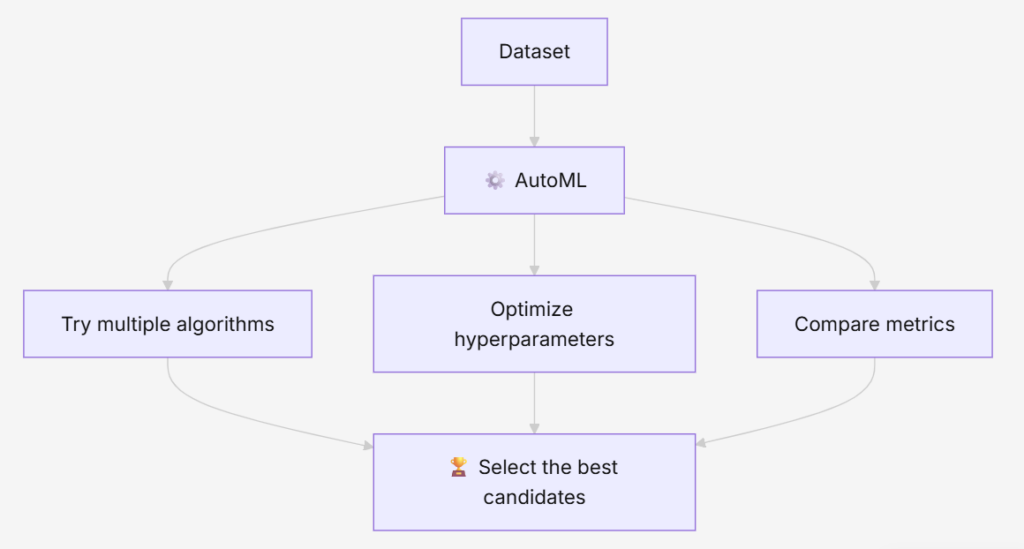
3. What tasks can AutoML automate
Depending on the platform, AutoML can handle a good chunk of the flow. Here’s a map of what the machine takes over:
| Stage | What it automates | Concrete examples |
|---|---|---|
| Data preparation | The initial cleaning | Imputing nulls, scaling, encoding categories |
| Feature Engineering | Creating variables | Derived variables, selecting the most relevant ones |
| Model selection | Testing algorithms in bulk | Logistic Regression, Random Forest, XGBoost, LightGBM, CatBoost, SVM |
| Optimization | The fine-tuning | Learning rates, depths, regularization, number of trees |
| Evaluation | The fair comparison | Accuracy, Precision, Recall, F1, ROC-AUC |
In other words: almost everything that in the previous chapters we did by hand, experiment by experiment, here happens in a single batch.
4. Where does PyCaret fit in?
PyCaret is an open source library built on top of Scikit-Learn that brutally simplifies the Machine Learning flow.
Where the traditional approach might require hundreds of lines of code (preparation, training, comparison, evaluation, saving), PyCaret reduces much of that work to a handful of functions. Look how compact it gets:
from pycaret.classification import *

# 1. Automatically prepare the data
setup(data=df, target="target")

# 2. Train and compare dozens of models at once
best_model = compare_models()
With those two lines, PyCaret prepares the data, trains multiple models, compares them against each other, and returns a ranking ordered from best to worst. Automatically.
5. What happens under the hood? (Spoiler: there’s no magic)
It’s tempting to believe PyCaret is witchcraft. It isn’t, and understanding this is key to using it well.

PyCaret doesn’t invent new algorithms. What it does is act like a conductor over Scikit-Learn: it takes the instruments that already existed, organizes them, automates their execution, and makes them far more accessible. The intelligence is the same as always; what changes is that the work of assembling it by hand disappears.
6. The most important idea: AutoML doesn’t replace the data scientist
If you take away only one thing from this chapter, let it be this. There’s a widespread myth:
«AutoML will replace data scientists.»
Reality is far more nuanced. AutoML automates tasks; it doesn’t automate understanding.
We still need a human for the decisions no machine can make on its own:
- defining which problem is worth solving,
- understanding the business context,
- validating that the data makes sense,
- interpreting the results with judgment,
- detecting dangerous biases,
- and taking responsibility for the final decisions.
The calculator analogy. When calculators became widespread, nobody fired the mathematicians. On the contrary: they stopped wasting time on tedious calculations and could devote themselves to far deeper problems. AutoML plays exactly that role.
7. Advantages and limitations: the two sides of the coin
Like any powerful tool, AutoML shines in some scenarios and stumbles in others. It’s worth knowing both sides before embracing it:
| ✅ Advantages | ⚠️ Limitations |
|---|---|
| Speed: going from hours or days to minutes. | Less control: you don’t always know why it chose that solution. |
| Productivity: lets you try many more alternatives. | Computational cost: testing dozens of models eats up resources. |
| Accessibility: lowers the barrier to entry into the discipline. | Black-box risk: it can hide important details. |
| Fast baselines: its best use, a competitive starting point in minutes. | No substitute for domain knowledge: an algorithm doesn’t understand your business. |
Notice one of the advantages, because it links directly to the chapter on iterative training: fast baselines. AutoML is perfect for generating, in minutes, that honest reference model against which you’ll later measure whether your sophisticated models actually add anything.
8. The role of AutoML in modern Machine Learning
Today AutoML is increasingly used for rapid prototypes, benchmarking, initial exploration of a problem, baseline generation, and general project acceleration.
And here’s the nuance that separates mature teams from beginners:
The best teams don’t use AutoML to stop thinking. They use it to think better.
They automate the repetitive precisely to free up time and devote it to the strategic: understanding the problem, questioning the data, and making good decisions.
In summary
AutoML was born to eliminate the most mechanical and tedious part of Machine Learning. Tools like PyCaret let you:
- prepare data with just a few lines,
- train and compare dozens of algorithms at once,
- optimize hyperparameters with no manual intervention,
- and evaluate results in a standardized way.
Its goal was never to replace the data scientist, but to multiply their productivity. And perhaps that’s the best way to understand it:
AutoML doesn’t automate human intelligence. It automates the tasks that keep you from spending more time on it.