



Monitoring and Drift: how to detect when a model starts failing without anyone noticing
The silent problem that ends up degrading all Machine Learning systems
Why a model that’s excellent today can turn into a mediocre one tomorrow.
There’s a scene that repeats over and over in Machine Learning projects.
A team spends weeks, sometimes months, building a model. The results are excellent, the metrics crush every target, the model is deployed, and everyone celebrates. End of project.
Right?
Not exactly. Because a few weeks later something strange starts to happen: predictions keep coming in, no errors appear, no alert goes off, the infrastructure runs like clockwork… and yet, little by little, performance begins to worsen. Silently. Almost invisibly. Without anyone touching a single line of code.
And here appears one of the most important lessons of modern Machine Learning:
All models degrade. The only unknown is when it will start happening.
It’s precisely to confront this that monitoring exists.
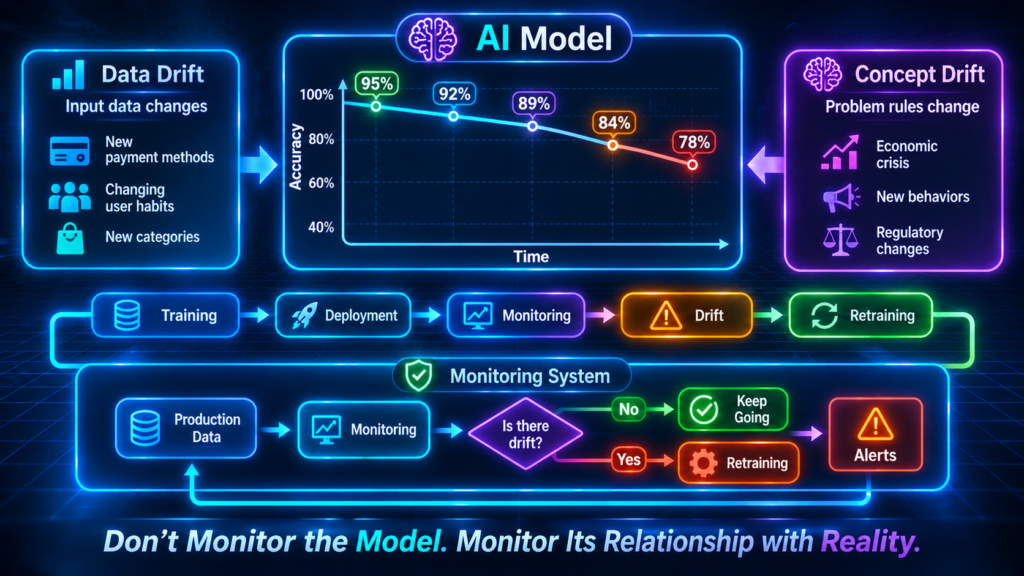
1. The great mistake: believing deployment is the finish line
As we already saw in the chapter on the lifecycle, many beginners imagine a process that ends at production:

But a real system never stops there. Deployment isn’t the finish line: it’s the starting gun for surveillance.

2. The autopilot analogy
Picture a plane with a perfectly calibrated autopilot. As long as the sky’s conditions stay stable, it flies beautifully, smooth and precise.
But the moment storms, turbulence, or sudden wind shifts appear, its behavior starts to drift. And not because the system is broken, but because the environment has changed.
A Machine Learning model suffers exactly the same phenomenon. It was trained for a specific world, with specific rules. And the world, barring exceptions, rarely stays still.
3. What does «monitoring» a model really mean?
Monitoring means continuously checking whether the system is still behaving the way we expect. But be careful, because there’s a very common misunderstanding: monitoring is not just knowing whether the server responds.
That’s the bare minimum. What we really want to know is much deeper:
- Does it still have the same accuracy as on deployment day?
- Do the incoming data resemble what we used to train it?
- Do the predictions keep the same distribution as always?
- Is the business still getting real value?
In one sentence:
We don’t monitor the model. We monitor its relationship with reality.
4. The two families of metrics
Monitoring usually splits into two big groups, and confusing their importance is a classic mistake:
| Technical metrics | Business metrics | |
|---|---|---|
| Question they answer | Is the machine working? | Is it any good for anything? |
| Examples | Latency, throughput, CPU/memory usage, errors per minute, timeouts | Does it sell more? Does it catch fraud better? Does it reduce incidents? |
| What they watch | The health of the infrastructure | The value it brings to the real world |
Technical ones matter, but business ones are usually the decisive ones. The reason is uncomfortable: a technically perfect model, one that responds in milliseconds and never fails, can be a complete flop if it has stopped adding value. A fast but useless system is still useless.
5. The silent enemy: Drift
And now we reach the star of this chapter. Drift means that something has changed compared to the environment in which we trained the model. And it happens far more often than it seems. It comes in two flavors that are worth not confusing.
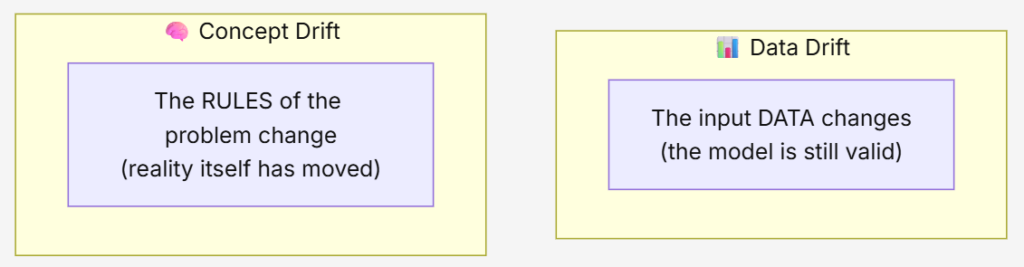
6. Data Drift: when the data changes
In this case, the model is still valid and its logic still works. The problem is that the data it receives now is different from what it saw during training.
Example: imagine a fraud detector trained on 2023 transactions. In 2026, new payment methods, cryptocurrencies, digital wallets, and completely different spending habits appear. The inputs have changed; the model has not.
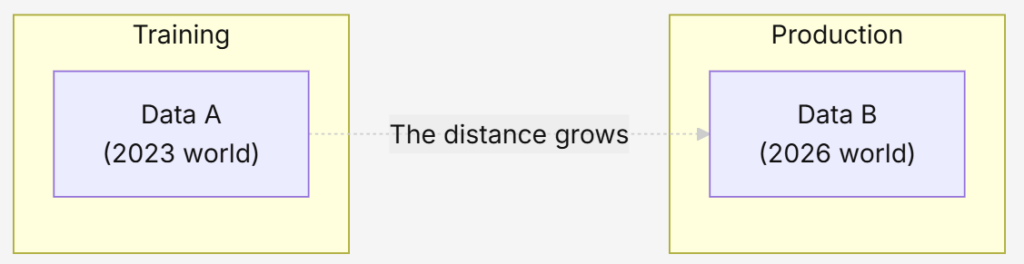
As the gap between «the data back then» and «the data now» widens, Data Drift appears, and with it, deterioration.
7. Concept Drift: when the rules of the game change
This one is more treacherous and more dangerous. Because here it’s not the data that changes: it’s reality itself. The relationship between cause and effect that the model learned stops being true.
The classic example: a system predicting a supermarket’s demand. Before 2020, the patterns were stable and the predictions reliable. Overnight, with an unexpected crisis, toilet paper and flour went from predictable products to panic items. The learned rules stopped holding, even though the input data looked almost identical to what it always was.
That’s the trap: Concept Drift can sneak in without the input figures raising the slightest suspicion.
8. Why is drift so dangerous?
Here’s the key to the whole chapter, and what makes it so treacherous:
Drift almost never generates a visible error.
The system keeps working, predictions keep coming in, the dashboards stay green, and everything looks fine. There’s no exception in the logs, no server down, no red alarm.
But quality degrades in silence, drop by drop. And many organizations only discover the problem months later, when the damage to the business is already obvious (and expensive). It’s a slow leak, not an explosion. And that makes it far harder to catch.
9. How drift is detected
There are many sophisticated statistical techniques, but the underlying idea is simple and elegant:
Continuously compare the training data with the current data, looking for significant differences.
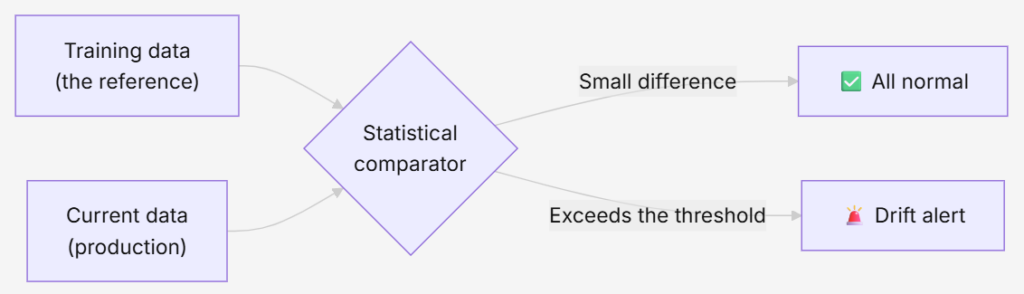
In practice, you watch aspects like distributions, means, frequencies, and the general behavior of each variable. When the difference between past and present exceeds certain predefined thresholds, the alert goes off.
10. What happens when we detect drift
Detecting the problem is only half the story. The other half is fixing it, and here we reconnect with the lifecycle:

That is, retraining. Monitoring and retraining are two sides of the same coin: one detects the deterioration, the other corrects it. Sophisticated alarms are useless if you don’t then act on them.
11. The best models aren’t the most accurate
This idea tends to surprise people, and it runs against the intuition of many teams obsessed with squeezing out 99% accuracy.
In production, a brilliant historical metric matters less than something far more valuable:
The ability to keep working when the world changes.
A slightly less accurate model, but well monitored and maintained, generates far more value in the long run than a dazzling model abandoned to its fate on deployment day. Sustained reliability beats fleeting brilliance.
In summary
All models start to degrade sooner or later. That’s why, once deployed, we must continuously watch:
- technical metrics (that the machine works),
- business metrics (that it keeps adding value),
- prediction quality,
- and the distribution of the input data.
The main enemy is Drift, in its two forms:
- Data Drift → the input data changes.
- Concept Drift → the rules of the problem itself change.
Monitoring exists precisely to detect these changes before the impact hits the business. And that is, perhaps, one of the loveliest lessons of modern Machine Learning:
Training a model is teaching it about the past. Monitoring it is checking whether it still understands the present.