





RTX AI Garage, Hermes Agent, and DGX Spark: NVIDIA’s Real Play in Agent Infrastructure
Most AI teams have agents that work in 5-minute demos and break in 5-hour production runs.
Between a notebook prototype and a system that scales in production lies a gap you can’t bridge with more prompts or more frameworks. You bridge it with infrastructure.
NVIDIA just published an article that targets exactly this problem. At first glance it looks like another product announcement, but reading between the lines reveals something more interesting: they’re sketching out the complete agent development stack for the next few years.
Let’s break it down.
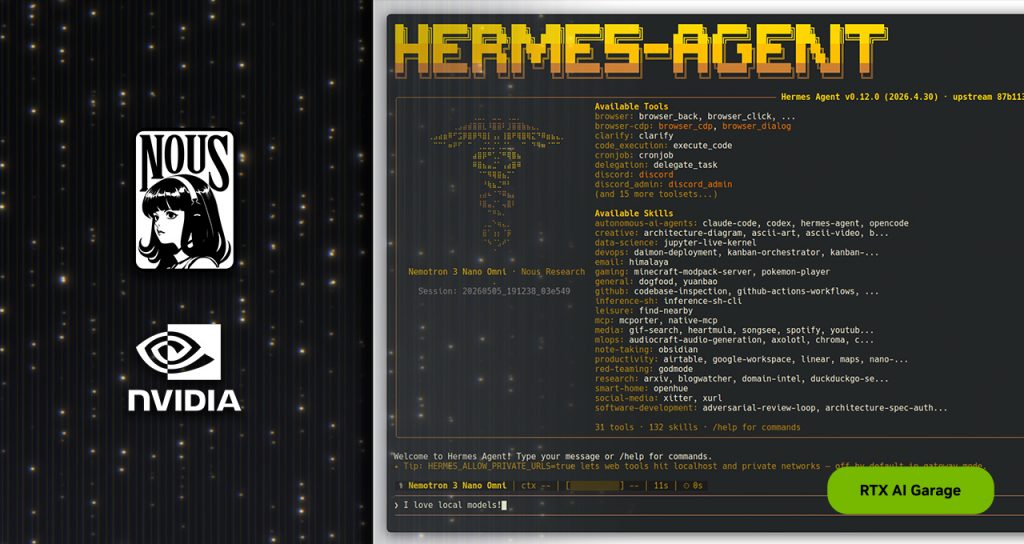
1. RTX AI Garage: your GPU as an agent lab
RTX AI Garage turns an RTX GPU into a complete environment for developing, testing, iterating, and deploying agents. No cloud, no API tokens, no waiting on quotas.
The idea is simple: your personal GPU becomes a mini-DGX.
This changes the rules for individual engineers, startups, and teams that need to iterate fast or work with data that can’t leave the machine. It’s the bridge between «I’m learning» and «I’m building something serious.»
2. Hermes Agent: operational agents, not demos
Hermes Agent is NVIDIA’s example of how modern agents should be built: multimodal, modular, capable of reasoning, planning, calling tools, and executing real actions on structured and unstructured data.
What’s interesting isn’t the agent itself. It’s the architecture it showcases:
- Modular and composable, not monolithic
- Native integration with RAG and memory
- Multi-step workflows with real execution, not just text generation
- Designed from day one to run on the NVIDIA stack
Hermes isn’t an assistant. It’s an operational agent. And that distinction is exactly where the industry is heading.
3. DGX Spark: the AI engineer’s personal datacenter
Here’s the most interesting move.
DGX Spark is a desktop mini-supercomputer designed to run AI workloads that previously only fit in a server rack. It’s not a laptop with a GPU. It’s not a gaming workstation. It’s a machine purpose-built to develop and iterate agents and models locally, with DGX architecture in a desktop form factor.
Why does it matter? Because it solves the most painful gap in agent development today: the jump between «it works on my notebook» and «I need to justify $50k a month in cloud spend to test the next version.»
With DGX Spark, an engineer can iterate on multimodal agents without paying for tokens, keep sensitive data 100% local, test full pipelines before deploying to production, and work offline with large models.
4. The real strategy: a hardware continuum
What NVIDIA is building isn’t four separate products. It’s a continuum:
| Stage | Hardware | Use case |
|---|---|---|
| Exploration | RTX AI Garage | Prototypes, demos, learning |
| Serious development | DGX Spark | Local agents, private data |
| Production | DGX (servers) | At-scale deployment, multi-tenant |
The same software stack runs across all three levels. The same agent you test on your RTX can scale to a DGX without rewriting anything.
That’s the play. It’s not about selling GPUs. It’s about removing infrastructure friction from the path between idea and production, as long as you stay inside the NVIDIA ecosystem.
5. My critical take
Three honest observations, because parroting the marketing message adds nothing:
1. NVIDIA isn’t inventing the concept, it’s verticalizing it. Frameworks like LangGraph, Ray, and vLLM already handle orchestration, distribution, and inference. What’s new isn’t the idea, it’s the vertical hardware-software integration. NVIDIA is the only company that can offer «the same binary runs from your desktop to your datacenter.»
2. The lock-in is real. The more you adopt this stack, the harder it is to leave. CUDA, TensorRT, NIM, and now DGX Spark. Each layer is excellent on its own, but together they create dependency. That’s not necessarily bad, it’s a conscious decision every team needs to make with eyes open.
3. The real competitor isn’t AMD. It’s the cloud. DGX Spark is a direct message to AWS, Azure, and GCP: you don’t need to rent GPUs to develop serious agents. If this works, it changes the economics of AI development for small and mid-sized teams.
6. What this means for the AI Engineer role
The 2024 AI Engineer was, in many cases, a prompt + notebook engineer. The 2026 AI Engineer is a distributed systems architect who happens to use LLMs.
Anyone who doesn’t make that transition gets left behind. The skills that matter now:
- Building agents that interact with real systems
- Integrating RAG, tools, and pipelines as part of an architecture, not as hacks
- Orchestrating multimodal, multi-step workflows
- Optimizing GPU inference
- Deploying across hybrid infrastructure (local + datacenter + cloud)
Read this way, the NVIDIA article is essentially a job description.
TL;DR
NVIDIA is shifting from selling GPUs to selling a continuum of agent infrastructure: from your local RTX (AI Garage) to your desk (DGX Spark) to your datacenter (DGX). Hermes Agent is the demo of how you build on top of that stack.
The real message: agents are systems, not models. And whoever controls the vertical stack of hardware, software, and orchestration, controls the enterprise AI market for the next five years.
fuente original: Hermes Unlocks Self-Improving AI Agents, Powered by NVIDIA RTX PCs and DGX Spark | NVIDIA Blog