





Ensemble Methods
The art of combining models to beat noise, variance, and complexity
How several weak models, working together, become one extraordinarily strong one.
So far we’ve met solitary algorithms, artists who work on their own. PCA flattens universes. LDA separates borders. LSA uncovers meaning. t‑SNE draws landscapes. Each one, in its own way, is self-sufficient.
But in machine learning there’s a whole family that doesn’t believe in solitude. It believes in collaboration. And its philosophy fits in a single sentence:
A weak model can fail. But a hundred weak models, well organized, can be unstoppable.
Welcome to Ensemble Methods.
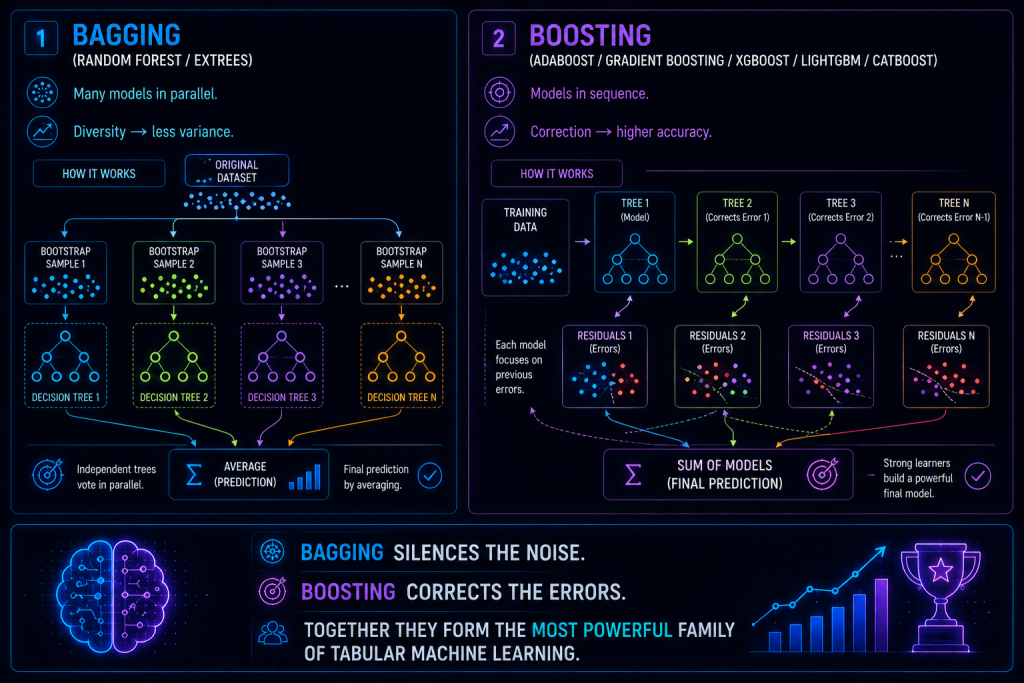
The core idea: why the crowd wins
The intuition is almost human, which is why it’s so appealing. Ask a single person and they might get it wrong. But ask a hundred different people and average their answers, and the result usually lands much closer to the truth. It’s the same phenomenon behind those «guess how many marbles are in the jar» contests, where the average of the whole crowd almost always beats any individual guess.
Ensembles exploit exactly that. By combining many models they manage to reduce variance (they stop panicking at noise), reduce bias (they capture patterns a single model would miss), gain robustness, and, used wisely, avoid overfitting. At heart, they’re nothing more than committees of models that vote, argue, and correct one another.
And within this family live two big personalities, two opposite ways of organizing the committee:
- Bagging → many models trained in parallel, each on its own.
- Boosting → many models trained in sequence, each one learning from the previous one’s stumbles.
Let’s look at each philosophy calmly.
Bagging: the forest that silences noise
Random Forest + ExtraTrees
Bagging comes from Bootstrap Aggregating, which sounds intimidating but means something simple: train many models in parallel, give each one a different sample of the data, and then average their predictions.
Why does it work so well with decision trees? Because trees have a virtue that looks like a flaw: they’re unstable. Change the data a little and the tree changes a lot. Individually, that makes them unreliable. But when you have hundreds of different trees and average their votes, that instability cancels out and the result becomes surprisingly stable. It’s like asking a thousand slightly distracted witnesses: each one misremembers a detail, but together they reconstruct the scene perfectly.
Two classics come out of this idea.
Random Forest, the most famous forest
Random Forest pulls two tricks at once to force diversity. First, the bootstrap: each tree sees a different subset of the data. Second, feature sampling: at each split, the tree can only choose among a handful of features, not all of them. The result is genuinely different trees, and that diversity is the heart of bagging.
That’s why Random Forest is so beloved: it’s robust, extremely hard to overfit, works well with almost no tuning, tolerates noise and missing values, and serves as an excellent baseline for nearly any tabular problem. When you don’t know where to start, start here.
ExtraTrees, the more chaotic version
ExtraTrees (Extremely Randomized Trees) raises the randomness stakes. Instead of carefully searching for the best split at each division, it picks splits at random. It sounds reckless, and it is, but it works: by adding more chance it gets even more diverse trees, trains faster, and reduces variance even further. Think of it as a Random Forest with more chaos and less computation.
Boosting: the algorithm that learns from its mistakes
AdaBoost
Boosting is the opposite philosophy. Instead of training models in parallel and averaging, it trains them one after another, and each new model devotes itself to fixing what the previous one got wrong.
AdaBoost was the first to do it well, and its idea is beautiful in how intuitive it is. Every time a point is misclassified, its «weight» goes up, as if it were shouting louder to demand attention. The next model then concentrates precisely on those difficult points. And so, round after round, the committee keeps sharpening exactly where it’s most mistaken. In the end it combines all the models, giving a louder voice to the ones that did best.
It’s basically a teacher who spends more time with the students who are failing.
That obsession with the hard cases is both its great strength and its Achilles’ heel. With clean data, AdaBoost is simple, elegant, and very effective. But when there’s noise or outliers, those «weird» points also demand attention, and the algorithm can end up fixating on errors that weren’t even worth correcting. Translation: with dirty data, it suffers.
Gradient Boosting: the father of modern models
Gradient Boosting takes AdaBoost’s idea and carries it into the realm of modern mathematics. Instead of raising the weight of difficult points, it does something more general and more powerful: each new tree tries to predict the error left by the previous one, using the gradient to figure out which direction to correct in.
The cycle is so clean it’s a pleasure to describe:
- You make a prediction.
- You calculate the error you made.
- You train a new tree to correct that error.
- You repeat the process.
- You add up all the trees.
Each tree is a small adjustment, an «almost, but a bit more over here,» and the sum of all those adjustments ends up being an enormously precise model. It’s so flexible and so powerful that it became the foundation on which the three heavyweights that come next were built: XGBoost, LightGBM, and CatBoost.
XGBoost: the engine that won Kaggle
XGBoost took Gradient Boosting and polished it into a competition machine. It added strong regularization so it wouldn’t overfit, learned to handle missing values on its own, parallelized itself to run fast, and was optimized almost obsessively.
The result was devastating on tabular data. For years, the recipe to win a Kaggle competition was practically one word: XGBoost. Its only downside is that squeezing every last drop out of it requires fairly fine-grained hyperparameter tuning.
LightGBM: pure speed
As datasets started to grow, XGBoost fell a little short on speed, and that’s where LightGBM came in with two clever ideas.
The first, histogram-based training: instead of examining every possible value one by one, it groups the data into buckets and works much faster. The second, leaf-wise growth instead of level-wise: the tree grows exactly where it’s most needed, going deeper into the problem areas rather than expanding uniformly.
The result is a blazingly fast algorithm, ideal for large datasets and numerical features. The price of that depth is that, if you don’t set limits, it can overfit easily.
CatBoost: the king of categories
CatBoost arrived to solve a historic headache: how to handle categorical variables (country, brand, customer type…) without resorting to one-hot encoding, which inflates the data, or falling into the dreaded leakage, when the model «cheats» by looking at information it shouldn’t.
Its solution is ordered encoding: it turns categories into numbers without spying on the future, that is, computing each value using only the information available up to that point. This eliminates leakage at the root and makes it very robust with datasets full of categories. It’s no accident that it’s the favorite in banking, retail, and insurance, sectors where these kinds of variables dominate everything.
The family portrait: when to use each one
| Model | Best for | Strengths | Risks |
|---|---|---|---|
| Random Forest | baseline, noise | robust and stable | less precise than boosting |
| ExtraTrees | speed | very fast and diverse | may lose precision |
| AdaBoost | clean data | simple and elegant | suffers with noise |
| Gradient Boosting | general use | flexible and powerful | slow without optimization |
| XGBoost | tabular data | regularization, missing values | complex tuning |
| LightGBM | large datasets | blazingly fast | risk of overfitting |
| CatBoost | categorical variables | avoids leakage | slower than LightGBM |
As a simple mental rule: start with Random Forest to get a reference point, and if you need to squeeze out the last drop of precision on tabular data, jump to boosting (XGBoost, LightGBM, or CatBoost depending on your problem).
In short
Ensemble methods are the proof of an idea that’s surprisingly powerful for how simple it is:
Diversity beats noise. Collaboration beats error. The sum beats fragility.
And with this, the family is nearly complete:
If PCA discovers dimensions,
and LDA discovers borders,
and LSA discovers meanings,
and t‑SNE discovers landscapes…
ensemble methods discover strength in numbers.
They’re the algorithm that looks at your weak models, smiles, and tells them:
«Together, we’re better.»